

Article audio
Listen to a generated narration of this post.
Have you ever noticed that sometimes a scent seems stronger or weaker even when nothing about the smell itself has changed? Why does a familiar perfume sometimes feel overwhelming and other times barely noticeable? Recent research sheds light on this mystery by showing that it’s not just the amount of odor molecules in the air that matters, but how our brain’s early olfactory circuits rhythmically communicate to shape our perception of odor intensity.
TL;DR
- The human olfactory bulb and piriform cortex use coordinated oscillations to encode how intense an odor is perceived, rather than just its physical concentration.
- This bidirectional brain activity supports a dynamic process that helps maintain stable perception of odor intensity across varying environmental conditions.
Sensing the intensity of stimuli is fundamental to all our senses. For example, we understand loudness in hearing and brightness in vision through well-studied brain mechanisms. However, how the brain processes the intensity of smells has remained elusive, especially in humans. Animal studies have suggested that the olfactory bulb and cortex encode odor concentration through specific neural firing patterns and oscillations. Yet, these studies couldn’t fully capture the subjective experience of odor intensity, which often doesn’t linearly match the physical concentration of odor molecules. This gap left open the question: how does the human brain translate raw chemical signals into the perceived strength of a smell?
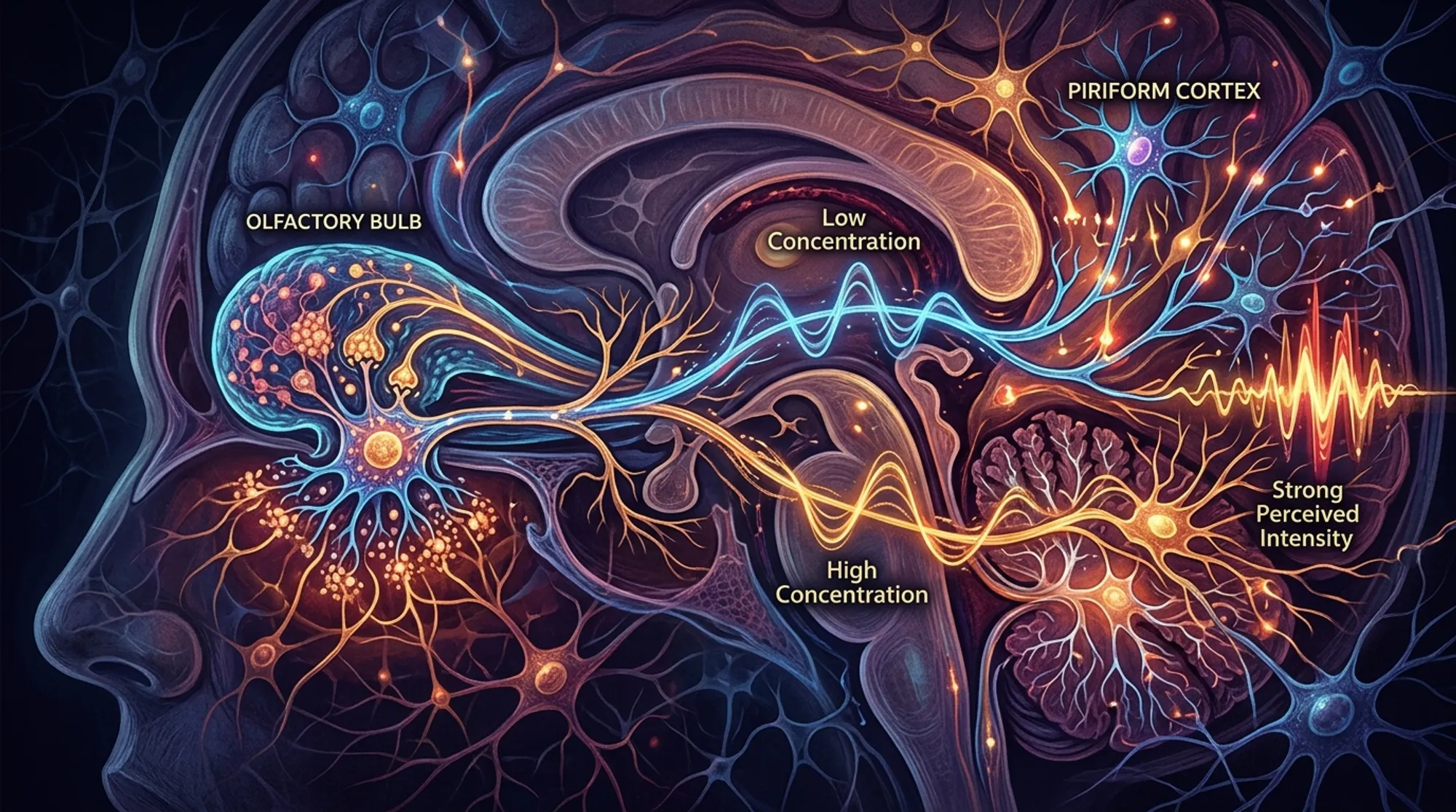
To investigate this, researchers employed a noninvasive technique called the electrobulbogram (EBG) to record brain activity from the olfactory bulb and piriform cortex simultaneously in human participants. Participants were exposed to odors at different concentrations and asked to rate how intense they perceived each smell. The team analyzed oscillatory brain activity—specifically gamma and beta frequency bands—and used advanced statistical models and machine learning classifiers to determine whether these neural rhythms reflected the physical odor concentration or the subjective intensity ratings.
Surprisingly, the results showed that oscillatory activity in both the olfactory bulb and piriform cortex correlated strongly with how intense participants perceived the odors, rather than the actual concentration of odor molecules. Early gamma-band activity in the olfactory bulb appeared to transmit perceived intensity information upward to the cortex. In turn, the piriform cortex sent back beta-band feedback to modulate olfactory bulb activity, creating a dynamic loop. This bidirectional communication was linked to phase–amplitude coupling and transient bursts of beta oscillations, mechanisms thought to support fine-tuned sensory processing. Importantly, attempts to decode odor concentration from these brain signals were unsuccessful, highlighting that the brain’s oscillatory patterns prioritize perception over physical stimulus properties.
These findings reveal a novel neural framework for how the human brain encodes the intensity of smells, emphasizing that perception is not a simple readout of the environment but an active construction shaped by ongoing brain rhythms. Understanding this oscillatory dialogue between the olfactory bulb and cortex deepens our insight into sensory processing and could inform future research on olfactory disorders, where perception and reality may diverge. Moreover, this work contributes to the broader neuroscience narrative that early sensory circuits use predictive and dynamic coding strategies to maintain stable and meaningful perception despite fluctuating external inputs.
While this study provides compelling evidence linking brain oscillations to perceived odor intensity, it is based on noninvasive recordings with inherent spatial and temporal limitations. The complexity of olfactory perception involves many brain areas beyond the olfactory bulb and piriform cortex, and future studies will be needed to map these broader networks. Additionally, the odors used were neutral in valence, so how emotional or contextual factors influence these oscillatory mechanisms remains to be explored. Finally, the findings focus on group-level effects, and individual differences in olfactory perception may involve additional neural dynamics.