
How Two Lemurs Share a Forest but Lead Very Different Lives: Insights for Conservation in Madagascar


Article audio
Listen to a generated narration of this post.
Madagascar’s forests are home to a dazzling array of lemurs, many of which face the threat of extinction. But even closely related species sharing the same forest can have very different survival prospects. Why does the Common Brown Lemur manage to persist while the Mongoose Lemur teeters on the brink? The answer lies in the subtle ways these species use their habitats — their ecological niches — and how those differences shape their vulnerability to environmental change.
TL;DR
- The Common Brown Lemur (Eulemur fulvus) occupies a broader and more continuous range of habitats across northwestern Madagascar’s dry-deciduous forests, while the Mongoose Lemur (Eulemur mongoz) is restricted to moist lowland forests near water sources.
- These niche differences suggest that conservation efforts should prioritize protecting moist lowland forest patches for the Mongoose Lemur and maintaining habitat connectivity for the more adaptable Common Brown Lemur.
Ecological niches describe how species interact with their environment — the specific conditions they need to survive and reproduce. Species with narrow, specialized niches tend to be more vulnerable to habitat loss and fragmentation because they rely on fewer habitat types and resources. Madagascar, a biodiversity hotspot, has lost nearly half its forest cover in recent decades, putting many lemurs at risk. Yet, even among closely related lemurs living side-by-side, extinction risks vary. Understanding these differences is key to crafting effective conservation strategies.
Researchers studied two lemur species in northwestern Madagascar’s Boeny region: the Vulnerable Common Brown Lemur and the Critically Endangered Mongoose Lemur. Using field surveys conducted during dry seasons from 2018 to 2021, they collected presence data for both species across two fragmented dry-deciduous forest landscapes — Mariarano Classified Forest and Ankarafantsika National Park. They combined this data with environmental variables such as vegetation moisture, elevation, and proximity to water bodies to build species distribution models. These models predicted where each species is likely to occur and allowed comparisons of their ecological niches and habitat preferences.
The models revealed that the Common Brown Lemur has a larger and more continuous predicted distribution — about 48,591 hectares — spanning a variety of forest types and conditions. In contrast, the Mongoose Lemur’s predicted range was much smaller, around 17,757 hectares, concentrated mainly in moist lowland forests near water basins. Despite sharing some environmental conditions, the Mongoose Lemur’s distribution was more spatially restricted. This suggests that factors beyond the measured environmental variables, such as behavioral traits or demographic constraints, may further limit its range. The findings support the idea that the Mongoose Lemur is a habitat specialist, while the Common Brown Lemur is more of a generalist.
These insights have direct implications for conservation. Protecting and restoring moist lowland forests near water bodies is critical for the survival of the Mongoose Lemur. Meanwhile, maintaining habitat connectivity across fragmented landscapes will help the Common Brown Lemur continue to thrive. By highlighting how subtle niche differences influence extinction risk, this study underscores the importance of tailored conservation strategies that consider species-specific habitat needs, especially in biodiversity hotspots facing rapid environmental change.
While the study provides valuable information on habitat preferences and predicted distributions, it also acknowledges limitations. The restricted range of the Mongoose Lemur cannot be fully explained by the environmental variables included, indicating that other factors such as social behavior, competition, or unmeasured habitat features may play important roles. Additionally, data were collected during dry seasons, which may not capture full seasonal habitat use. Future research incorporating more environmental variables and behavioral studies will help refine conservation approaches.
Figures
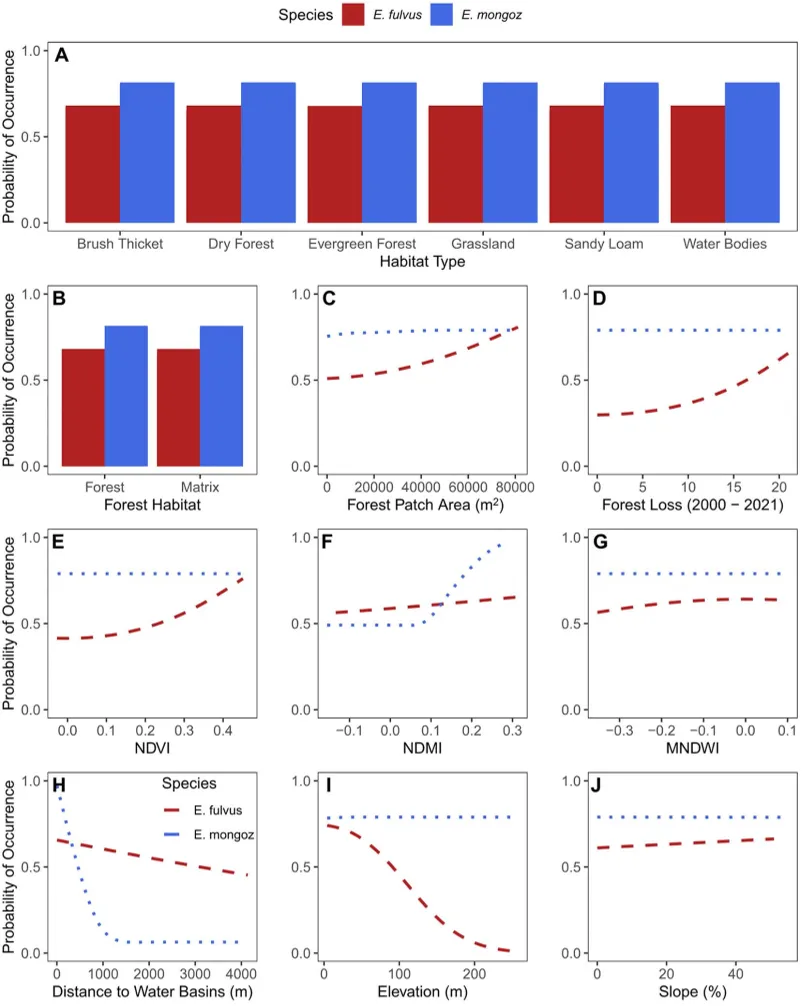 Graphs show how changes in environmental factors affect the chances of finding E. fulvus and E. mongoz species.
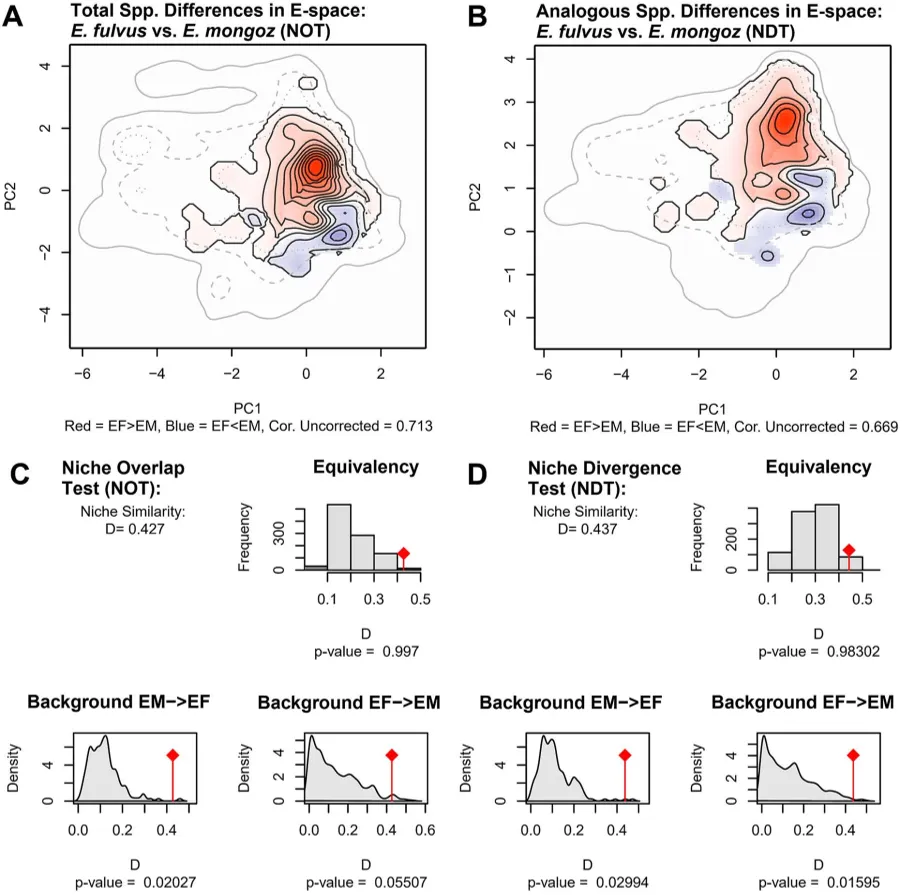 This figure compares habitat use and overlap between two species in Madagascar, showing how their environmental preferences differ and overlap.
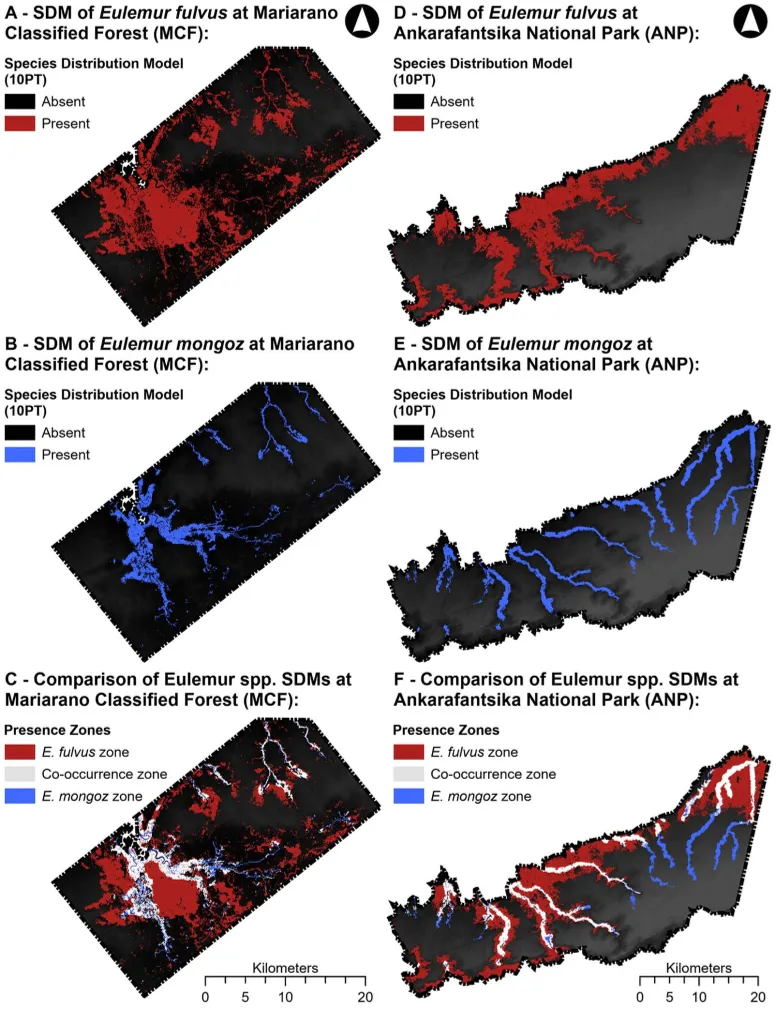 Maps show where two species live in two forests, highlighting areas unique to each and where they overlap, based on satellite and field data.