

Article audio
Listen to a generated narration of this post.
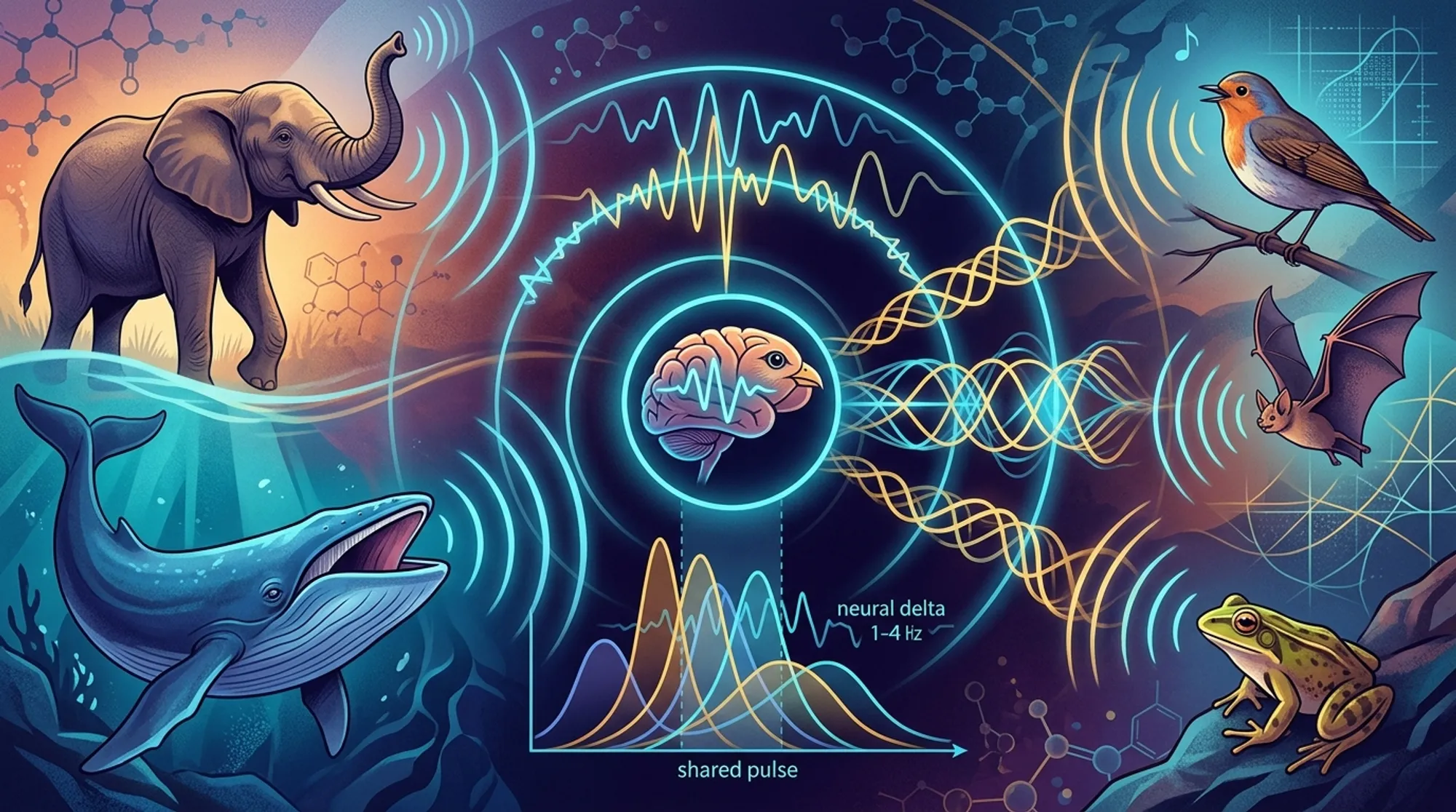
Did you know that animals as different as birds and mammals might be tapping into the same secret rhythm when they communicate? Recent research has uncovered a surprising pattern: across nearly 100 species, the tempo of animal calls centers around a slow, steady beat of about 2.7 times per second. This rhythm aligns with a fundamental brain wave frequency known as the delta range, hinting at a deep evolutionary connection that shapes how animals talk to one another.
TL;DR
- Animal acoustic communication rhythms cluster around an optimal tempo of roughly 2.7 Hz, a frequency within the neural delta brain wave range.
- This conserved rhythm predates the divergence of mammals and birds, suggesting a universal neural basis for acoustic communication across diverse animal species.
Acoustic signals are vital for animals to convey information—whether to attract mates, warn of predators, or coordinate social interactions. While much research has focused on the spectral qualities of these sounds, like pitch and frequency, the temporal patterns or rhythms of calls have remained less understood. In humans, rhythm plays a crucial role in speech comprehension, with brain oscillations syncing to the pace of syllables and phrases. But do similar rhythmic patterns exist in animal communication, and if so, what drives their evolution? This study set out to explore these questions by analyzing a broad range of species, including mammals, birds, amphibians, reptiles, fishes, and insects.
The researchers compiled acoustic data from 98 species, mainly mammals and birds, but also including other vertebrates and insects. They focused on measuring the rhythmic modulations in the amplitude of animal calls—essentially the tempo at which sounds rise and fall. Using robust computational methods to extract these rhythms, they then applied phylogenetic regression models to test whether factors like body weight, chewing behavior, environmental conditions, or social complexity influenced rhythm evolution. Crucially, they controlled for evolutionary relationships between species to distinguish shared ancestry effects from species-specific adaptations. They also compared evolutionary models to determine whether rhythms evolved randomly or were conserved around an optimal value.
Contrary to expectations, the study found no significant influence of anatomical traits, environmental factors, or social complexity on the rhythms of animal calls. Instead, rhythms clustered tightly around an optimal tempo of about 2.7 Hz, which falls within the delta frequency range of brain oscillations (1–4 Hz). Phylogenetic modeling showed that this rhythm is strongly conserved across species and likely existed in the last common ancestor of mammals and birds over 300 million years ago. Additional data from amphibians, insects, and fishes suggest this conserved rhythm may be even older. These results imply that animal communication rhythms are not shaped primarily by physical constraints or ecological pressures, but rather by a universal neural mechanism linked to conserved brain activity patterns.
This discovery bridges evolutionary biology and neuroscience, revealing a fundamental rhythm that underlies acoustic communication across a vast array of animals. By linking communication tempo to ancient neural oscillations, the study suggests that brain rhythms provide a shared channel facilitating effective intra- and interspecies communication. Understanding this conserved rhythm enriches our knowledge of how communication systems evolved and may inform future research in bioacoustics, animal behavior, and neural processing. It also highlights the deep evolutionary roots of rhythmic patterns, connecting human speech rhythms to those of other animals through a common neural heritage.
While the study presents compelling evidence for a conserved acoustic rhythm, the dataset is heavily weighted toward birds and mammals, with fewer species from other groups. This limits the certainty about how universal the rhythm is across all animal taxa. Additionally, some potentially relevant factors, like vocal complexity and beak morphology, could not be fully incorporated due to data limitations. The study also focuses on macroevolutionary patterns and does not address short-term or context-specific variations in communication rhythms. Further research including more diverse species and exploring neural mechanisms directly will be essential to deepen our understanding of this intriguing phenomenon.