
Active but Not Passive: How Plant Viruses Hijack Insect Vectors to Spread

Article audio
Listen to a generated narration of this post.
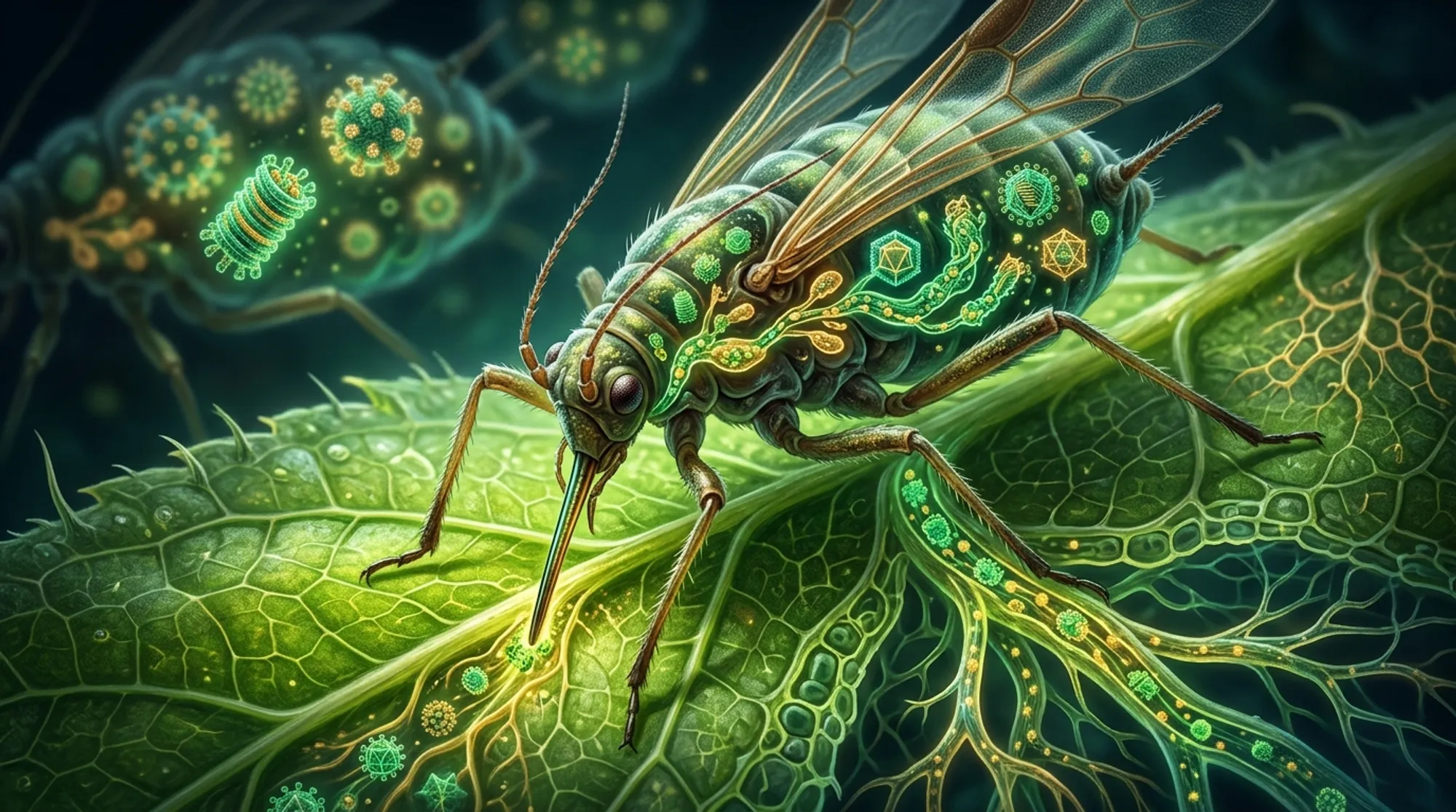
Did you know some plant viruses can hijack insects to spread themselves more effectively? Unlike mere hitchhikers, certain plant viruses actively manipulate the insects that carry them, reshaping their biology and behavior to jump from plant to plant with greater success. This fascinating interplay between viruses, plants, and insects reveals a complex biological strategy that influences crop health and ecosystem dynamics.
TL;DR
- Persistent-propagative plant viruses replicate inside insect vectors and directly alter their physiology, morphology, and behavior to improve virus transmission.
- These viruses manipulate insect neural signaling, feeding behavior, wing development, and even circadian rhythms, often using the same viral proteins to affect both plants and insects.
Most plant viruses rely on insects to move between plants, but they are far from passive passengers. Over millions of years of coevolution, many plant viruses have evolved sophisticated ways to manipulate both their plant hosts and the insect vectors that spread them. Persistent-propagative viruses, in particular, invade and replicate within insect vectors, enabling them to directly influence the insect’s biology. This contrasts with nonpersistent viruses, which are carried externally or briefly within insects. Understanding these interactions is crucial because plant viral diseases threaten global food security by damaging crops and spreading rapidly through insect vectors.
Researchers have combined molecular biology, virology, entomology, and plant pathology approaches to uncover these virus-insect interactions. Studies use genetic and protein interaction analyses to identify viral proteins that target insect neural or hormonal pathways. Behavioral assays observe changes in insect feeding, movement, and wing development after infection. Advanced microscopy and molecular techniques track viral replication within insect tissues, including nervous systems. These methods together reveal how viruses manipulate insect vectors both indirectly—by altering plant defenses and attractiveness—and directly—by reshaping insect physiology.
Recent discoveries show that persistent-propagative plant viruses employ dual strategies to enhance transmission. For example, barley yellow striate mosaic virus (BYSMV) produces a protein that suppresses plant defenses to attract insect vectors and simultaneously disrupts the insect’s circadian clock to increase locomotion and feeding. Rice stripe virus (RSV) reduces physical barriers in the insect’s feeding stylet by promoting degradation of chitin-binding proteins in plants, facilitating virus uptake. RSV also induces long-winged morphs in male planthoppers by modulating insulin signaling pathways, promoting insect dispersal and wider virus spread. These viruses can infect insect nervous systems, subtly altering neural signaling without harming the vector, ensuring efficient virus propagation and transmission.
These insights reveal that plant viruses are active participants in their transmission cycles, not just passive cargo. By manipulating insect vectors at molecular and behavioral levels, viruses optimize their spread and persistence in agricultural ecosystems. This knowledge opens new avenues for controlling plant viral diseases by targeting virus-vector interactions rather than just the plants or insects alone. For instance, disrupting viral effects on insect behavior or development could reduce virus transmission and crop losses. Understanding these complex interactions also enriches our broader comprehension of host-parasite coevolution and ecological networks.
While progress has been substantial, many molecular details of virus-vector manipulation remain unclear, and most studies focus on a limited number of virus and insect species. The ecological consequences of these manipulations in natural environments are complex and influenced by multiple factors, including other organisms and environmental conditions. Additionally, translating these findings into practical disease control strategies will require careful evaluation to avoid unintended effects on beneficial insects or ecosystems. Continued research integrating molecular, ecological, and applied perspectives is essential to fully harness this knowledge.